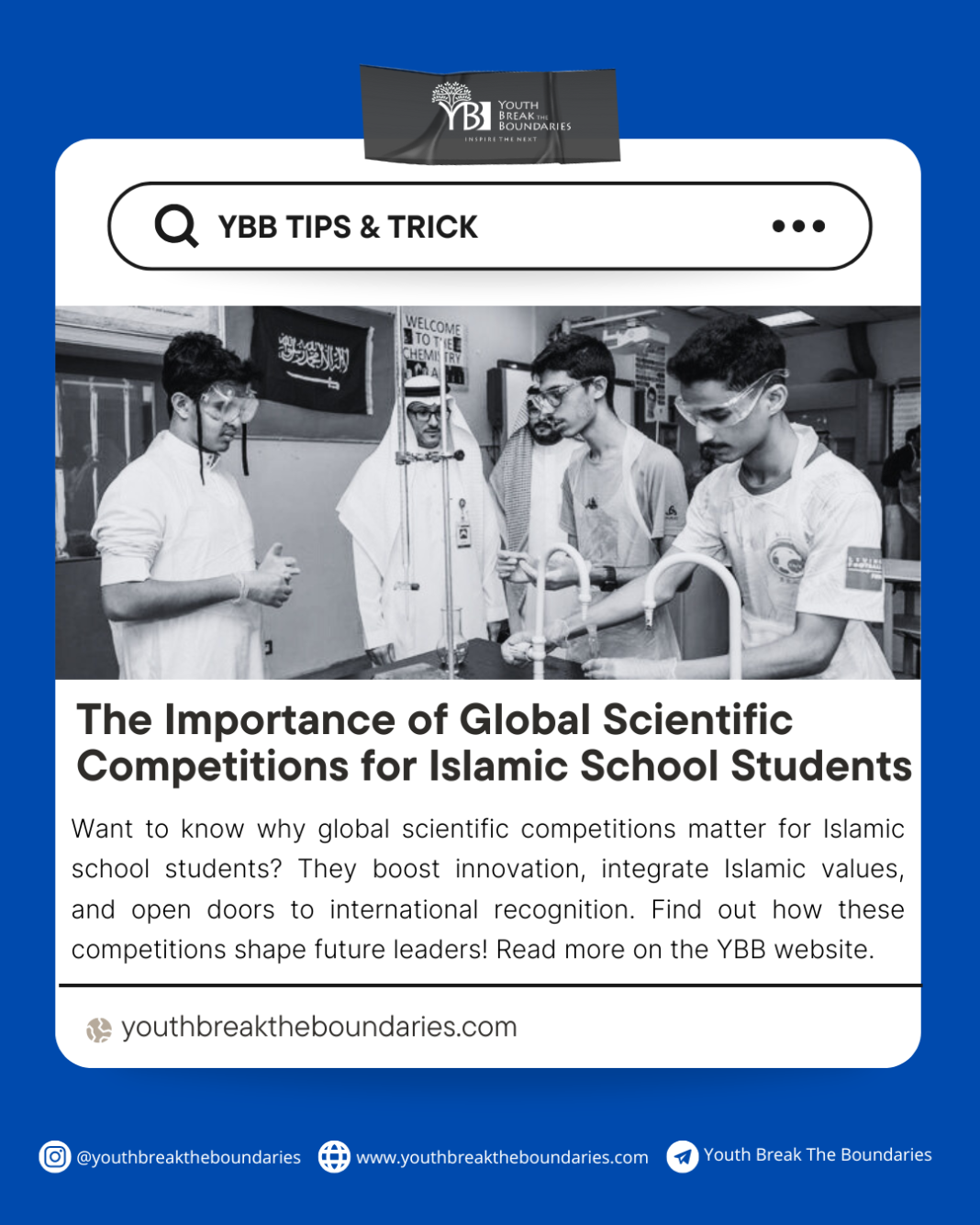

Scientific competitions play a crucial role in shaping the future of education. In Indonesia, these competitions are particularly significant for students in Islamic schools.
Not only do they enhance academic achievements, but they also foster tolerance and broaden global perspectives. Moreover, such competitions introduce local innovations to a global audience, ensuring their relevance in today’s world.
The Benefits of Global Scientific Competitions
Engaging in international competitions offers numerous advantages, including:
- Gaining international recognition.
- Integrating Islamic values with scientific innovations.
- Creating practical solutions based on moral principles.
Islam highly values the pursuit of knowledge. This is evident in the Quran, specifically in Surah Al-Mujadalah (58:11) and At-Taubah (9:122). These verses emphasize that knowledge protects individuals from misguidance.
Another crucial aspect to consider is the negative stigma often associated with Islamic education. Cases involving misconduct by a few individuals have tarnished the reputation of some institutions. However, scientific achievements can help rebuild this image, even though they are not the ultimate solution.
From Local Wisdom to Global Relevance
International scientific competitions focus on sustainability, innovation, and social justice. Islamic school students in Indonesia have the opportunity to explore local wisdom while presenting faith-based solutions to global challenges. For example:
- Implementing zakat systems to address social inequality.
- Showcasing Islamic artistic traditions such as calligraphy and batik.
- Promoting traditional Muslim attire like sarongs and peci as cultural identities.
There are numerous success stories of Islamic school students excelling in international competitions. Several Islamic schools in Bogor, for instance, have consistently produced top researchers and scientific writers.
According to Darunnajah.com, young researchers from SMP Islam Terpadu Nurul Fikri, Bogor, won a gold medal at the International Conference of Young Scientists (ICYS) in the Netherlands.
Similarly, students from SMP Islam Amalina, Tangerang Selatan, achieved three awards at the SEAMEO Search for Young Scientists (SSYS) competition. Their project, a “Water Quality Measuring Robot,” received recognition in the STEM category.
These achievements demonstrate that Islamic schools in Indonesia contribute significantly to global scientific knowledge. They also prove that students from these institutions can excel in science and technology.
Government and Private Sector Support
The Indonesian government, through institutions such as BRIN and the Ministry of Research and Technology, actively supports student participation in international competitions. This support includes:
- Research funding.
- Awards for outstanding students.
- Curriculum integration with research-based education.
Additionally, well-known scholarship programs such as LPDP and special university admission pathways for competition winners provide further incentives. Programs like “Kampus Merdeka” and the Student Creativity Program (PKM) also nurture young researchers’ talents and interests.
Besides government initiatives, private organizations offer scholarships for talented students. Some of these foundations include:
- Khazanah Ilmu Foundation
- Dompet Dhuafa
- Tanoto Foundation
With combined efforts from the government and private sector, the study of Islam can contribute positively to global scientific advancements.
Conclusion
Scientific competitions are more than just a platform for awards. They serve as proof that knowledge and moral values can go hand in hand. Encouraging young minds to participate in these events will help shape a future where Islamic education is synonymous with innovation and excellence.
Explore our social media to learn more about us and stay updated with our latest news and activities!
Instagram: @youthbreaktheboundaries
Facebook: Youth Break the Boundaries
Youtube: @ybbfoundation
Telegram: @Youth Break The Boundaries
Tik Tok: @youthbreaktheboundaries