
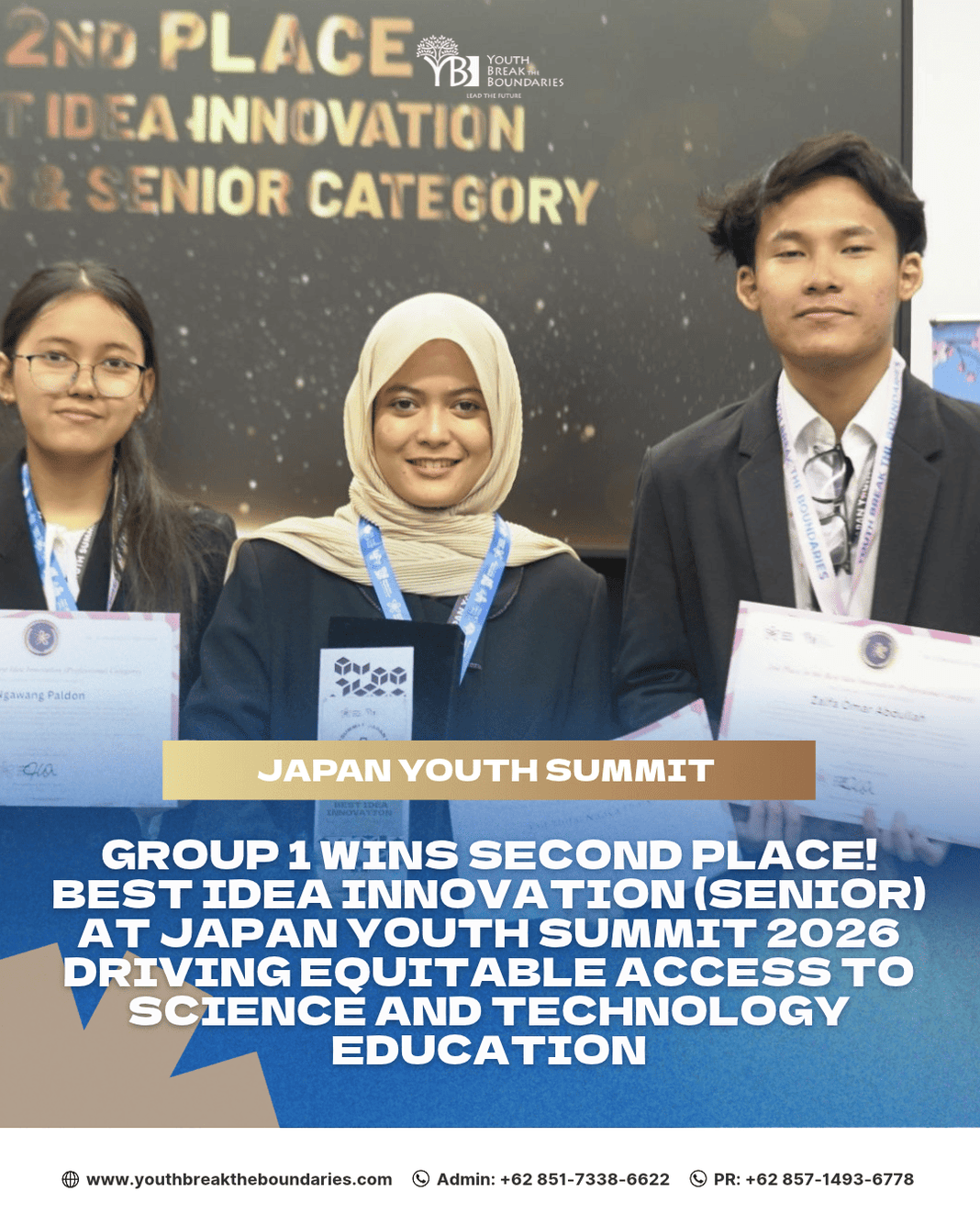

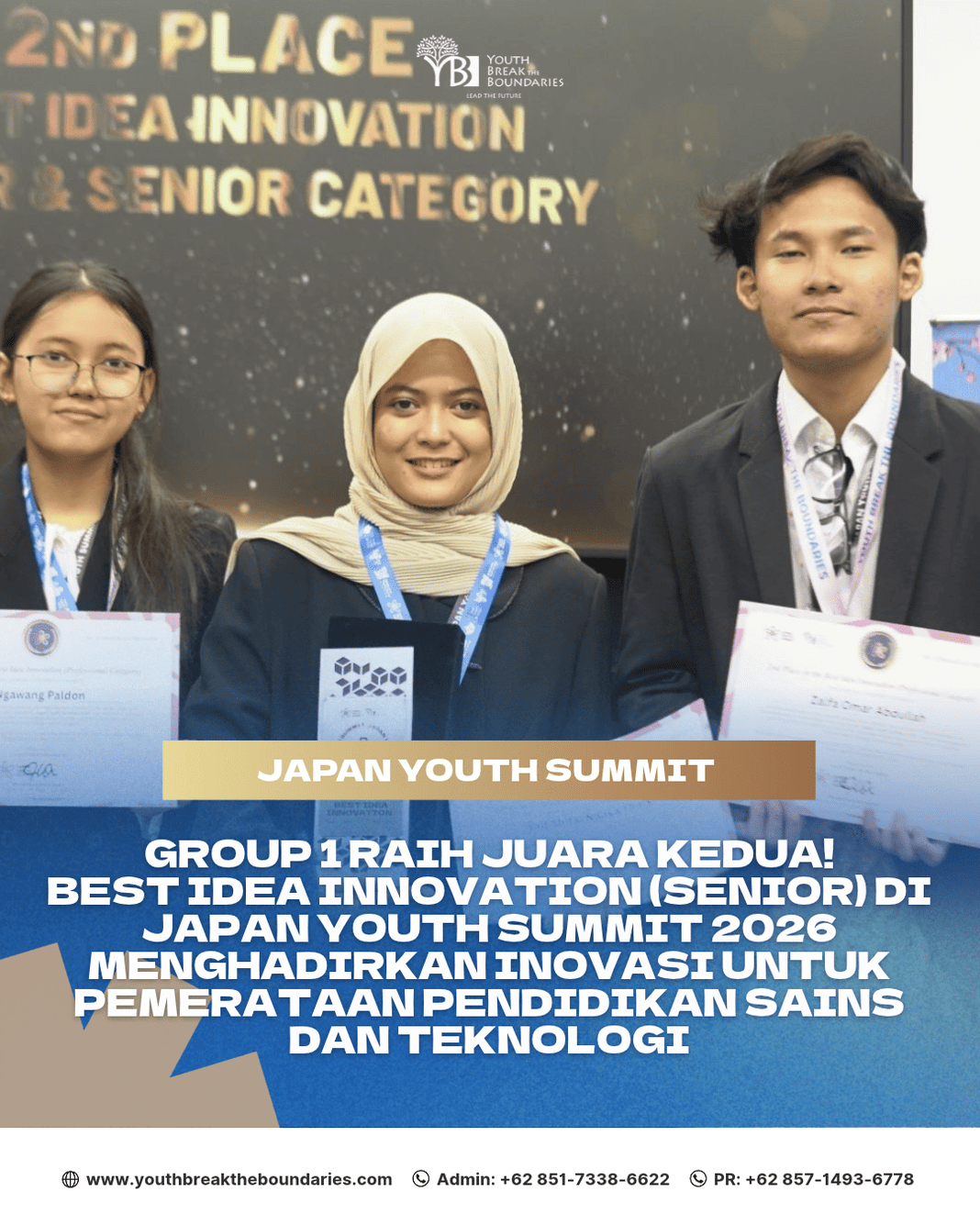
OSAKA, JEPANG —Group 1 secured Second Place in the Best Idea Innovation (Senior) category at the Japan Youth Summit (JYS) 2026 Autumn Edition with its project, “Developing a Science and Technology Education System Based on SDG 4.” The project focuses on improving the quality of and expanding equitable access to science and technology education, particularly for students in rural areas and communities facing economic challenges.
Aligned with Sustainable Development Goal 4 (SDG 4), which promotes inclusive and equitable quality education, the team proposed an approach that combines policy support, educational technology, and collaboration among governments, communities, and industries.
Meet the Members of Group 1
Group 1 consists of three participants from Indonesia and India:
- Cut Thifal Nadya Thary — Indonesia
- Zalfa Omar Abdullah — Indonesia
- Ngawang Paldon — India
Through this project, the team highlighted the importance of access to science and technology education in strengthening critical thinking, encouraging innovation, and preparing young people to address global challenges.
Addressing Inequalities in Science and Technology Education
Group 1’s project identifies several challenges that continue to limit equitable access to education. Economic disparities can prevent schools and students from accessing adequate learning facilities. Meanwhile, schools in rural areas often face shortages of trained teachers and laboratory equipment.
Beyond geographical and financial barriers, gender stereotypes and social and cultural norms can also discourage girls from participating in science and technology education. Furthermore, the COVID-19 pandemic exposed inequalities in technology access and schools’ readiness to implement digital learning.
These challenges demonstrate that educational equality requires solutions tailored to the circumstances of each community, particularly those with limited access to educational facilities and learning resources.
Strategies for More Equitable Education
To address these challenges, Group 1 proposed several complementary strategies.
First, collaboration between governments and industries is essential to support infrastructure development, provide learning resources, and improve the quality of science and technology education. These efforts should also include education funding advocacy and financial assistance to prevent economic constraints from becoming barriers to learning.
Second, distance learning and mobile learning can help expand educational access, particularly for schools in remote areas. With adequate infrastructure and technological support, students can access a wider range of learning resources despite limited facilities in their schools.
Third, implementing inclusive and gender-sensitive curricula is crucial to creating learning environments that offer equal opportunities to all students. This approach aims to reduce social and cultural barriers that limit girls’ participation in science and technology fields.
By combining these strategies, the project promotes an education system that can better adapt to students’ needs and the conditions of different communities.
Reaching Students with Limited Educational Access
The proposed program primarily targets rural areas and communities experiencing financial constraints. Its main beneficiaries include students with limited access to adequate educational facilities, girls facing social and cultural barriers, and remote schools that need better infrastructure and greater access to science and technology learning.
By prioritizing these groups, the project places equitable access at the center of educational improvement. Sustainable implementation will require ongoing support from multiple stakeholders to ensure that the proposed solutions address communities’ actual needs.
Advancing SDG 4 Through Collaboration
Group 1’s initiative aligns with SDG 4, which promotes inclusive, equitable, and quality education for all. The project also emphasizes that the use of technology must be supported by effective policies, adequate funding, and specific attention to groups at risk of educational exclusion.
Through this approach, science and technology education can go beyond improving facilities to expand learning opportunities regardless of students’ economic backgrounds, gender, or geographical location.
Muhammad Aldi Subakti, Chairman of Japan Youth Summit 2026, congratulated Group 1 on their achievement in addressing educational inequality through innovation.
“Congratulations to Group 1 on this achievement. We hope their idea continues to develop and inspires other young people to make education more inclusive. Keep achieving and creating innovations that bring positive change,” said Aldi.
About Japan Youth Summit 2026
The Japan Youth Summit (JYS) 2026 Autumn Edition was organized by Youth Break the Boundaries (YBB) in Osaka, Japan, from October 19–22, 2026. Under the theme “Beyond Limits: Youth Leading the Next Era of Innovation and Global Stability” and the tagline “Innovate for Tomorrow,” the summit brought young people together to exchange ideas, develop innovative solutions, and strengthen international collaboration.
Through project competitions and cross-cultural exchanges, JYS encourages participants to develop ideas that address global challenges and contribute to sustainable development.
Conclusion
Group 1’s achievement in securing Second Place in the Best Idea Innovation (Senior) category highlights the role of young people in addressing educational inequality through innovative approaches. By combining technology-enabled learning, inclusive curricula, education funding support, and cross-sector collaboration, the project proposes a framework for expanding access to science and technology education. Ultimately, it reinforces the principle that quality education should be accessible to every student, including those living in communities with limited resources.


 at Japan Youth Summit 2026 with a project promoting equitable access to science and technology education under SDG 4.)