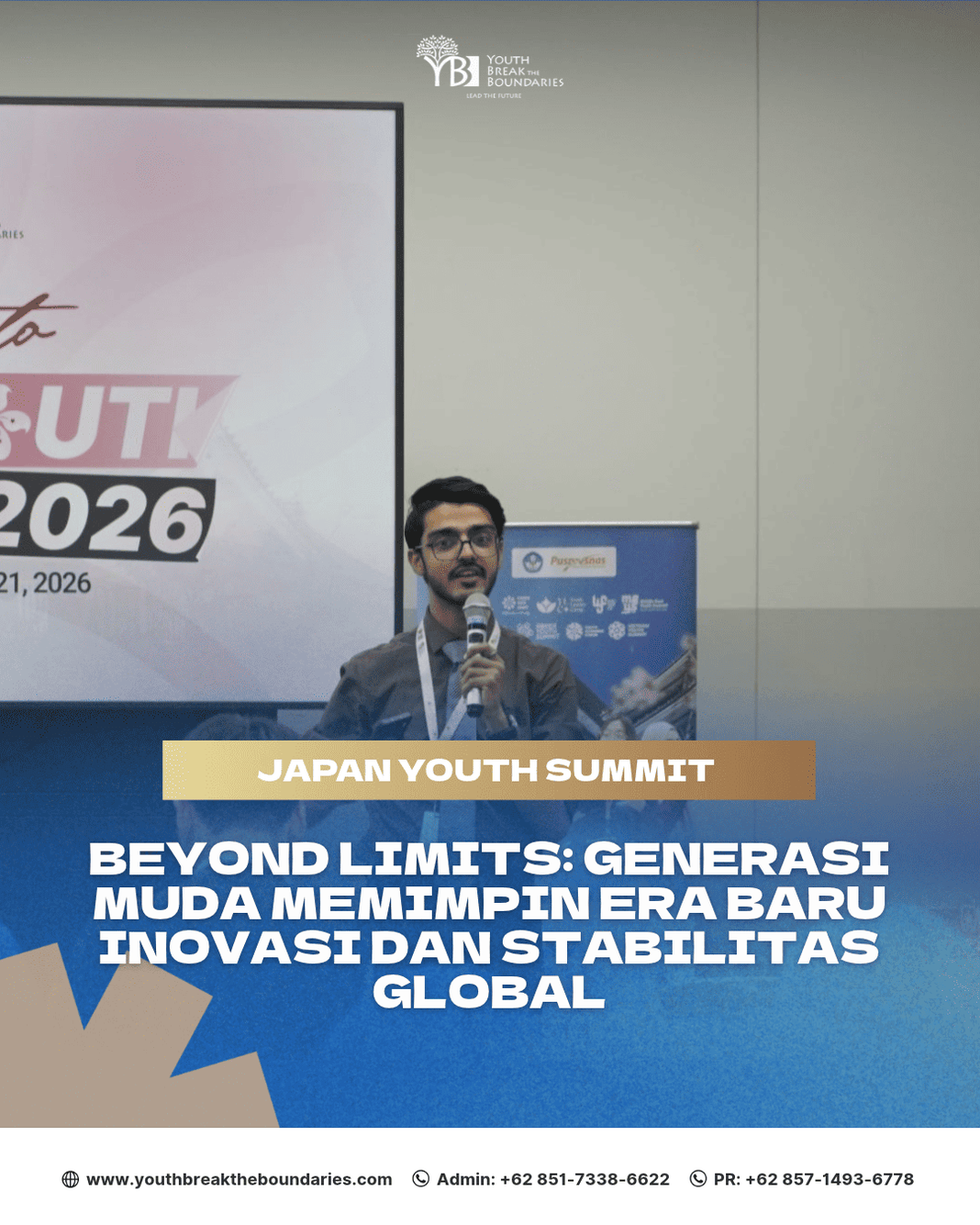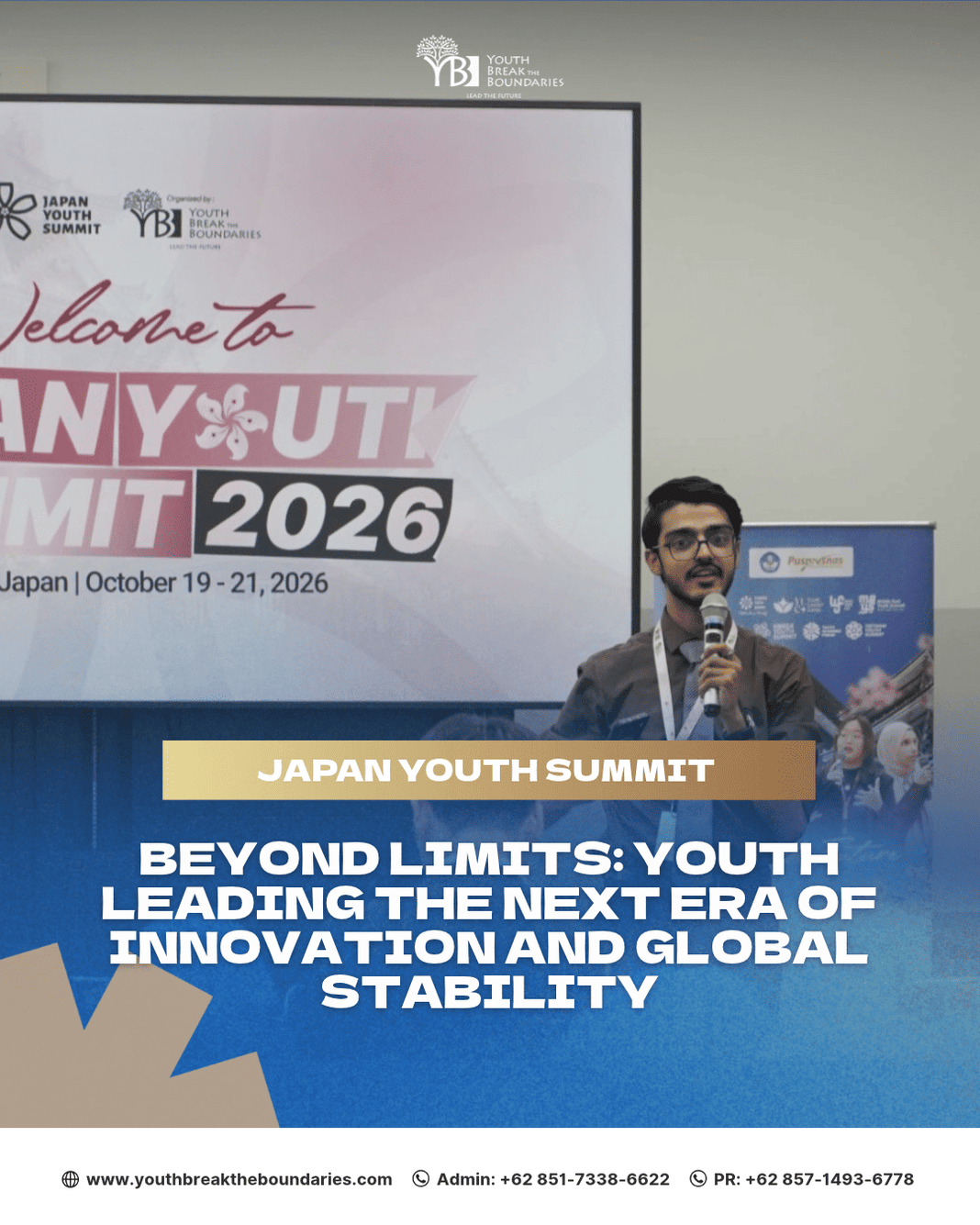

Osaka, Japan — The Japan Youth Summit (JYS) 2026 Autumn Edition was successfully held on October 19–22, 2026, in Osaka, Japan. As the fourth edition of the Japan Youth Summit organized by Youth Break the Boundaries (YBB), this international program brought together 29 delegates from five countries: Indonesia, India, Malaysia, Georgia, and Canada.
Under the theme “Beyond Limits: Youth Leading the Next Era of Innovation and Global Stability” and the tagline “Innovate for Tomorrow,” JYS 2026 encouraged young people to explore innovation and collaboration as approaches to addressing global challenges. Furthermore, the summit highlighted the role of technology and sustainability in supporting the achievement of the Sustainable Development Goals (SDGs).
Throughout the four-day program, delegates participated in cultural exchanges, academic visits, group project presentations, an international symposium, and an award ceremony. Each activity provided opportunities for participants to broaden their perspectives, build cross-border connections, and explore new approaches to sustainable development.
Day 1 — Welcoming the Japan Youth Summit 2026 Delegates
The first day of Japan Youth Summit 2026 began with the arrival and pickup of delegates at Kansai International Airport in Osaka. Upon arrival, participants were transferred to Hotel Plaza Osaka, where they stayed throughout the program.
In the evening, delegates attended a networking session at Uopuku Restaurant. This gathering allowed participants to meet one another, exchange introductions, and begin building connections with fellow delegates from different countries.
The session marked the beginning of an international experience centered on cultural diversity and collaboration. By bringing together participants from different backgrounds, JYS 2026 created an environment that encouraged the exchange of perspectives and the development of meaningful relationships.
Day 2 — City Tour and University Visit
On the second day, delegates explored several academic, cultural, and historical destinations in Osaka and its surrounding areas. The activities provided an opportunity to experience Japan beyond the conference setting and gain a deeper understanding of its educational environment and cultural heritage.
Academic Visit to Kindai University
The itinerary began with a visit to Kindai University, where delegates gained insights into the Japanese higher education environment and university life. The visit also encouraged participants to reflect on the role of higher education in preparing young people to navigate future challenges.
Cultural Exploration at Katsuoji Temple
The journey continued to Katsuoji Temple, a historic Buddhist temple known for its daruma dolls, which symbolize good fortune, perseverance, and determination.
Through this visit, delegates had the opportunity to learn about an important aspect of Japanese cultural traditions and explore the values associated with persistence and personal growth.
Discovering Japan’s History at Osaka Castle
The final destination was Osaka Castle, one of Japan’s most recognized historical landmarks. The visit offered participants a closer look at Japan’s history and cultural heritage, complementing their academic and cultural learning experiences.
Following the tour, delegates enjoyed bento meals provided by Cafe Bintang, which offers halal-certified food.
Overall, the second day’s activities combined academic exploration, historical learning, and cultural exchange, allowing participants to experience different dimensions of Japanese society.
Day 3 — International Conference, Group Project Presentations, and Cultural Night
The third day featured the summit’s main academic activities, including group project presentations, an international symposium, a cultural night, and an award ceremony.
Group Project Presentations
During the group project presentation session, delegates presented ideas and proposed solutions addressing challenges related to society and sustainable development.
Participants had the opportunity to explain their approaches, communicate their ideas in a structured manner, and exchange perspectives with an international audience. The session also provided a platform to strengthen their communication, critical thinking, and collaboration skills.
In line with the JYS 2026 theme, the presentations emphasized the importance of youth participation in developing innovative ideas that respond to real societal needs. Through this process, delegates were encouraged to connect their knowledge with potential real-world applications.
The session demonstrated how young people can contribute to meaningful change by combining creativity, critical analysis, and collaboration in addressing shared challenges.
International Symposium: Global Perspectives on the SDGs
The international symposium featured five speakers with expertise in academia, scientific research, global communications, and technological innovation.
Discussions explored several Sustainable Development Goals, particularly Quality Education, Decent Work and Economic Growth, Industry, Innovation and Infrastructure, and Sustainable Cities and Communities.
The following speakers contributed their expertise and perspectives to the symposium.
1. Denada Florencia Leona, MD — Lecturer at Universitas Andalas, Indonesia, and Doctoral Student at Kyoto University, Japan
Focus: SDG 4 — Quality Education
Dr. Denada Florencia Leona is a physician, lecturer at Universitas Andalas, and doctoral candidate at Kyoto University in Japan. Her research focuses on emergency medical services and prehospital care.
As an LPDP scholarship recipient and awardee at international medical conferences, she brought perspectives on the importance of education, research, and cross-border contributions. Her background highlighted how academic development and knowledge exchange can support professional growth and broader societal progress.
2. Prof. Sastia Prama Putri, Ph.D. — The University of Osaka, Japan
Focus: SDG 8 — Decent Work and Economic Growth; SDG 9 — Industry, Innovation and Infrastructure
Prof. Sastia Prama Putri is an Indonesian scientist and professor at the Graduate School of Engineering, The University of Osaka. Her expertise includes biotechnology, biochemistry, and metabolomics, with a focus on scientific innovation and sustainable solutions.
She also founded Wellness by Bright Squad, an initiative that connects scientific knowledge with innovation and entrepreneurship.
Her work illustrates the potential of scientific research to create opportunities for innovation, economic development, and sustainable growth.
3. Yudai Katami — Osaka Innovation Hub, Japan
Focus: SDG 8 — Decent Work and Economic Growth; SDG 9 — Industry, Innovation and Infrastructure
Yudai Katami is a global communications and startup ecosystem professional who serves as Deep Tech Support Team Coordinator at Osaka Innovation Hub.
With experience in public relations, robotics, international business development, and cross-border partnerships, he focuses on strengthening connections between startups, global investors, and innovation ecosystems.
His professional experience offered insights into the role of international collaboration in supporting entrepreneurship and technological advancement.
4. Dr. Prashant Kumar — Center for Integrative Medical Sciences, Yokohama, Japan
Focus: SDG 9 — Industry, Innovation and Infrastructure; SDG 11 — Sustainable Cities and Communities
Dr. Prashant Kumar is a research scientist specializing in advanced magnetic materials, nanocomposites, and technologies for nuclear magnetic resonance (NMR) and magnetic resonance imaging (MRI) applications.
With multidisciplinary research experience and numerous scientific publications, he contributes to the development of materials and technologies with potential applications in innovation and sustainable solutions.
His expertise demonstrated how scientific research can contribute to technological progress and address emerging societal needs.
5. Dr. Sunil Luhar — Bhavira Technologies, Australia
Focus: SDG 9 — Industry, Innovation and Infrastructure; SDG 11 — Sustainable Cities and Communities
Dr. Sunil Luhar is a scientist, researcher, and entrepreneur who founded Bhavira Technologies in Australia.
His expertise includes electrochemistry, electrode fabrication, critical metal recovery, and circular economy technologies. Through his company, he develops sustainable solutions that transform waste into valuable resources.
His work highlights the importance of technological innovation in promoting resource efficiency and advancing sustainable industrial practices.
Together, the five speakers offered diverse perspectives on the connections between education, scientific research, economic growth, and innovation. Their contributions encouraged delegates to recognize that achieving the SDGs requires interdisciplinary approaches, technological advancement, and international collaboration.
Cultural Night and Award Ceremony
Following the academic sessions, delegates participated in a cultural night featuring cultural performances. The event celebrated diversity and provided an opportunity to introduce Indonesia’s cultural heritage to the international community.
The first performance featured the Nusantara Dance Performance by SMAN 1 Gresik, showcasing the richness of Indonesian traditional dance. MAN 2 Malang also contributed to the celebration with a performance that formed part of the cultural program.
Following the performances, the event continued with an award ceremony recognizing the delegates’ participation, creativity, leadership, and contributions throughout the summit.
The combination of cultural performances and the award ceremony celebrated two important aspects of Japan Youth Summit: the value of cultural diversity and the potential of young people to collaborate and develop innovative ideas.
Day 4 — Farewell Session and Program Closing
The fourth day marked the conclusion of Japan Youth Summit 2026 Autumn Edition.
Before departing, delegates wrote messages and reflections about their experiences through a postcard activity. This session allowed participants to reflect on the lessons they had learned, the experiences they had shared, and the connections they had established during their time in Japan.
Following the farewell session, participants checked out of the hotel and were transferred to the airport for their return journeys to their respective countries.
Although the program concluded in Osaka, the knowledge, friendships, and perspectives gained throughout the summit offered delegates a foundation for continued learning and future collaboration.
Conclusion
Empowering Young People to Innovate for Tomorrow
Japan Youth Summit 2026 Autumn Edition brought together 29 delegates from five countries over four days, combining cultural exploration, academic experiences, international discussions, and the development of innovative ideas.
Through its diverse program, JYS 2026 provided a platform for young people to exchange perspectives, strengthen leadership skills, and explore the role of innovation in addressing global challenges. The summit also emphasized the importance of connecting education, technology, sustainability, and international collaboration to advance the Sustainable Development Goals.
Muhammad Aldi Subakti, Chairman of Japan Youth Summit 2026, expressed his appreciation to all delegates:
“We appreciate all delegates for giving their best commitment throughout Japan Youth Summit 2026. We hope that the experiences and ideas developed during the program will not stop in Osaka, but will continue to grow into real initiatives that bring benefits to society.”
Through Japan Youth Summit 2026, Youth Break the Boundaries (YBB) hopes that delegates will carry their knowledge, connections, and spirit of collaboration back to their communities. By turning insights into action, young people can contribute to positive social change, promote sustainable development, and help shape a more innovative and inclusive future.