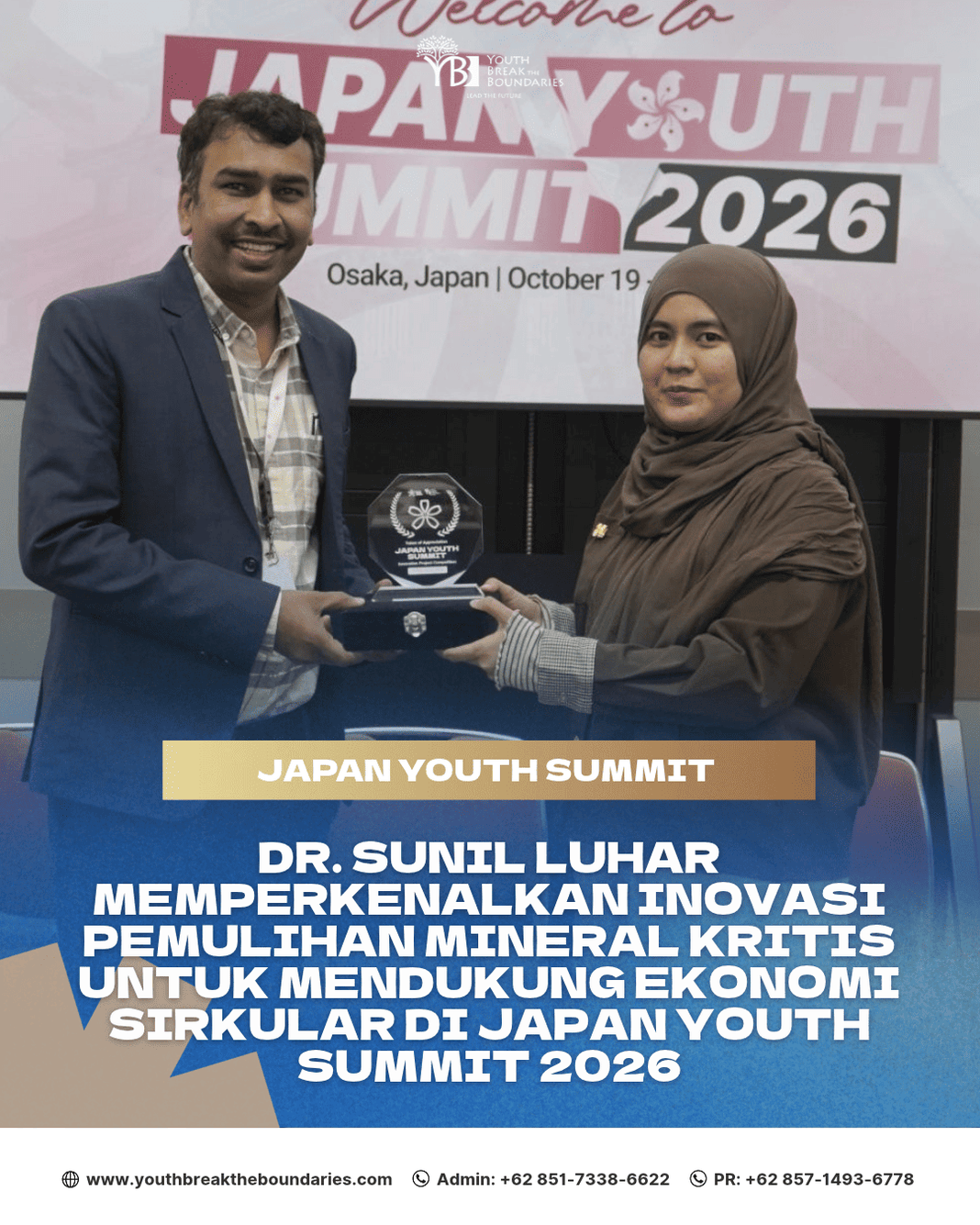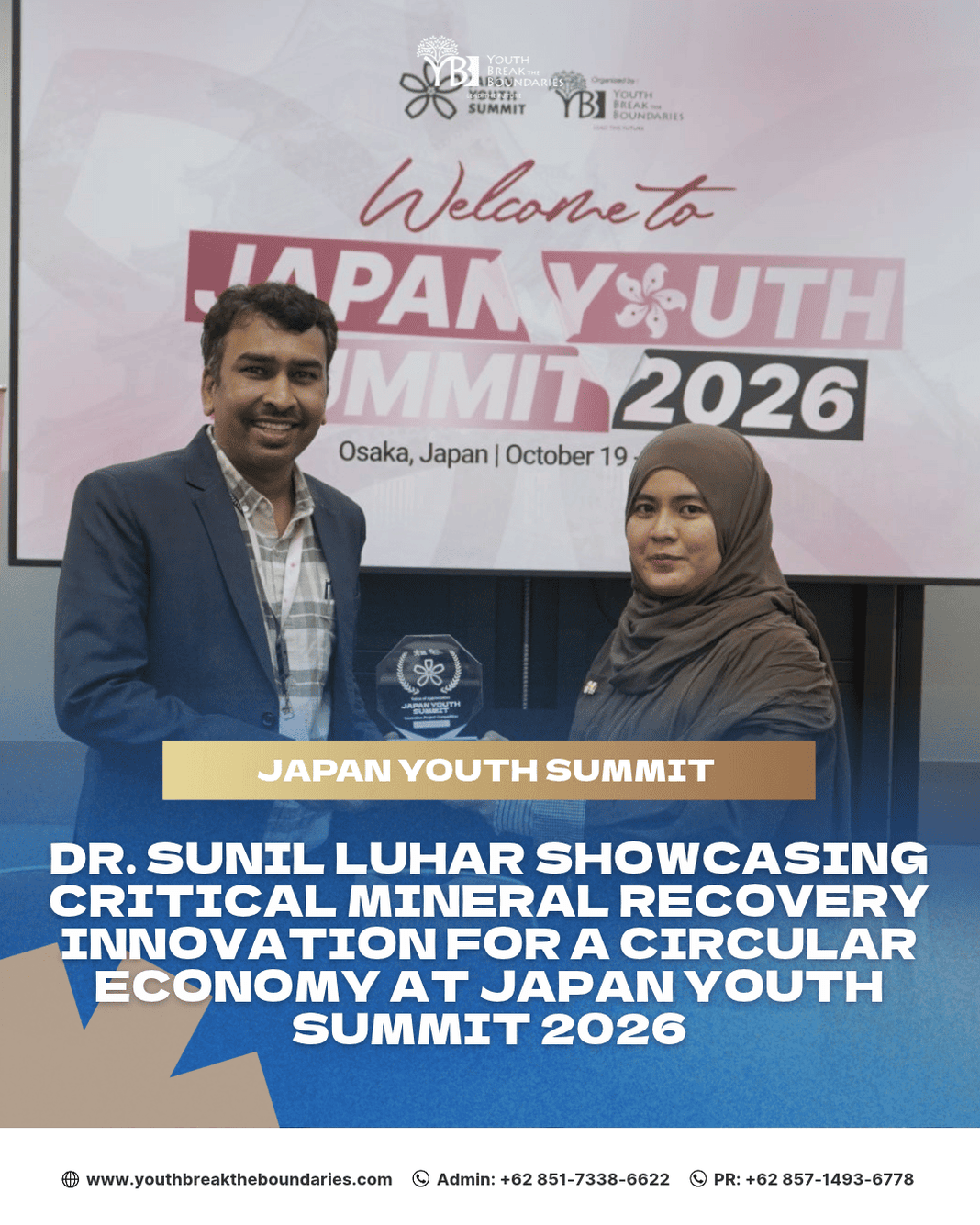

OSAKA, JEPANG —Dr. Sunil Luhar, Founder and CEO of Bhavira Technologies, shared insights into technological innovation and waste recovery as solutions to sustainability challenges at the Japan Youth Summit (JYS) 2026 Autumn Edition. His session demonstrated how scientific research can be translated into practical solutions that benefit both industry and the environment.
Dr. Luhar has a background in physics and completed a joint PhD focused on electrochemistry through CSMCRI Bhavnagar and RMIT University. Having grown up attending government schools in rural India, his journey illustrates how one’s background does not have to define future opportunities.
Turning Waste into Valuable Resources
During his presentation, Dr. Luhar discussed the growing challenge of securing critical minerals, including lithium, cobalt, nickel, copper, and rare earth elements. These materials are essential to modern technologies, from electronic devices to clean energy systems. However, rising demand also creates challenges for resource availability and supply-chain resilience.
At the same time, electronic waste and mine wastewater contain valuable materials that could be recovered and reused. To address this challenge, Bhavira Technologies is developing electrochemical technology that recovers metals from waste streams through a process known as electrowinning.
The company uses an affordable, corrosion-resistant graphite-polymer composite electrode, partially synthesized from waste polystyrene packaging foam. This innovation demonstrates how discarded materials can be repurposed to support resource recovery and more sustainable industrial processes.
From Scientific Research to Industrial Solutions
Dr. Luhar also highlighted the process of transforming laboratory research into technologies that can operate at an industrial scale. This requires several stages, including testing, scaling up, developing pilot systems, and validating performance before wider implementation.
Through Bhavira Technologies, founded in Victoria, Australia, in early 2026, he demonstrated how scientific innovation can evolve into a technology-driven business. The company’s early progress included participation in pre-accelerator programs, patent filings, international validation, and initial revenue generation.
His journey also offered an important lesson for young innovators: failure can provide valuable data for improvement. Developing successful innovations requires asking meaningful questions, learning from mentors, gathering supporting evidence, building viable prototypes, and demonstrating measurable impact.
Driving Sustainable Development Through Innovation
Bhavira Technologies’ circular-economy approach supports several United Nations Sustainable Development Goals (SDGs), including:
- SDG 9: Industry, Innovation and Infrastructure
- SDG 11: Sustainable Cities and Communities
- SDG 12: Responsible Consumption and Production
- SDG 13: Climate Action
By recovering minerals from waste, this approach offers a way to use resources more efficiently while supporting the development of more sustainable technologies and industrial practices.
Conclusion
Through his presentation at Japan Youth Summit 2026, Dr. Sunil Luhar demonstrated how sustainable innovation can begin with real-world challenges and develop through focused scientific research. His journey from researcher to technology entrepreneur also encouraged young people to turn scientific knowledge into practical solutions that benefit industry, society, and the environment.
About Japan Youth Summit 2026
The Japan Youth Summit (JYS) 2026 Autumn Edition was organized by Youth Break the Boundaries (YBB) in Osaka, Japan, from October 19–22, 2026. Under the theme “Beyond Limits: Youth Leading the Next Era of Innovation and Global Stability” and the tagline “Innovate for Tomorrow,” the summit provided a platform for young people to exchange ideas, explore innovation, and strengthen international collaboration.