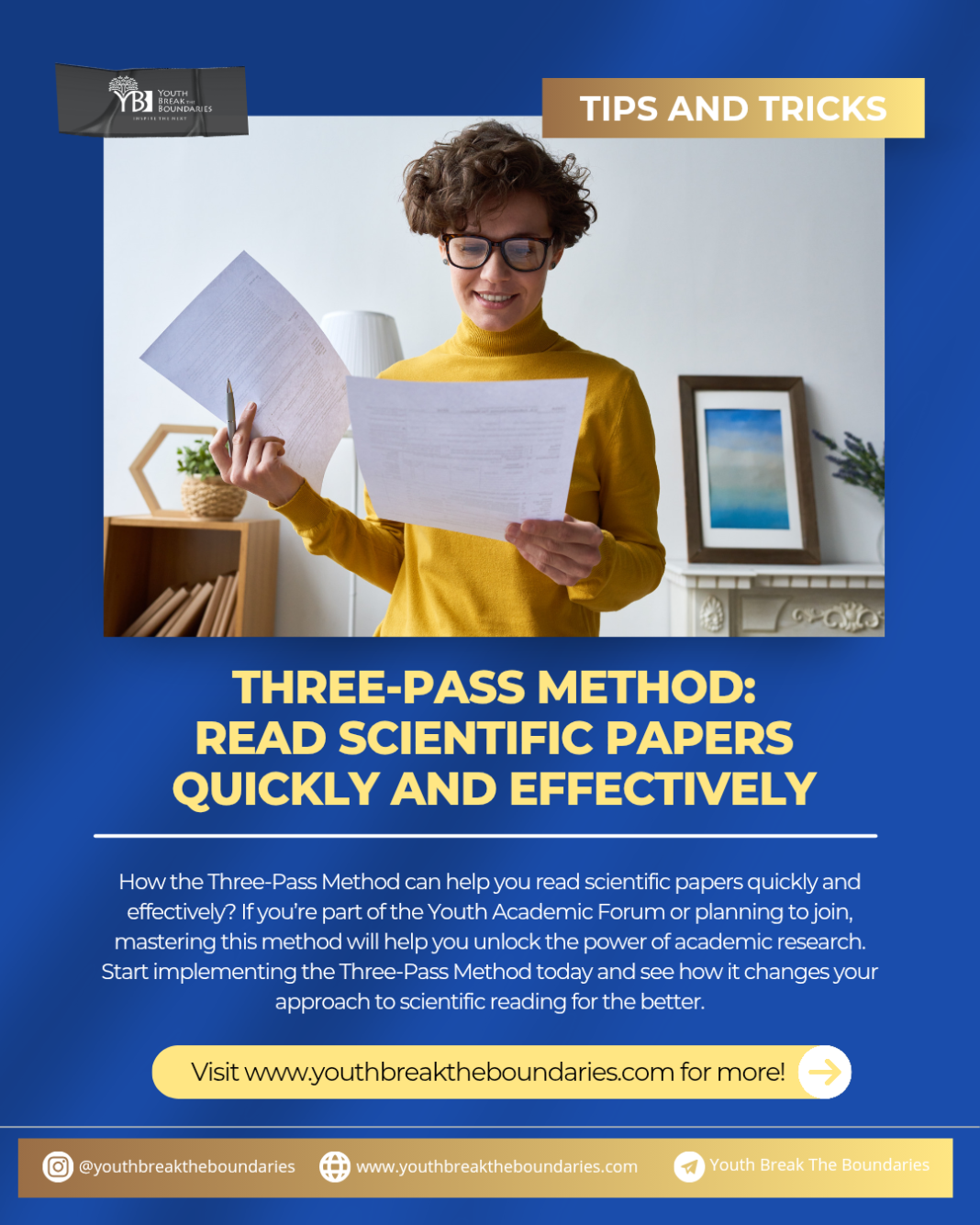

Many young people are eager to master reading scientific papers. If you are also starting your research journey, understanding the Three-Pass Method will help you read more efficiently with greater understanding.
What Is the Three-Pass Method?
The Three-Pass Method is a structured way to read scientific papers. Invented by S. Keshav, this approach involves passing through a paper up to three times. Each pass has its own purpose.
This technique makes reviewing scientific articles manageable. Instead of struggling with every word from the beginning, you build knowledge step by step. Here’s how each pass works.
Also read: Write Like a Pro: 3 Main Tips to Avoid Plagiarism in Scientific Papers
First Pass: The Quick Overview
Goal: Get a bird’s-eye view of the paper.
Time Needed: 5-10 minutes
- Read the title, abstract, and introduction for the main theme.
- Check section and subsection headings to see the paper’s structure.
- Glance at the conclusion to find out the results.
- Look at the references and see if you recognize any papers.
After this pass, ask yourself:
- What problem is the paper discussing?
- Is this paper useful for your purpose?
- Should you read it more deeply?
This first pass is not about technical detail. You are trying to understand the category and purpose. You can stop after the first pass if the paper does not fit your needs.
Also read: Where to Find Reliable International Research Journals: A Guide for Young Researchers
Second Pass: Understanding the Core Ideas
Goal: Grasp the main points and argument flow.
Time Needed: Up to 1 hour
- Pay attention to figures, diagrams, and tables. They often summarize results or methods.
- Carefully read the results and discussion sections.
- Annotate key points and highlight unfamiliar terms.
- Note down important references for follow-up.
At this stage, you try to summarize the research in your own words.
Think about:
- What is the core message?
- How did the authors support their claims?
- What evidence did they find?
If you still find the paper unclear or very complex, you can decide whether to study additional background material before returning to the paper. Otherwise, move on to the final pass for full understanding.
Third Pass: Deep Dive and Critical Analysis
Goal: Understand all the details and evaluate the research critically.
Time Needed: Several hours, as needed
- Read the methodology in detail. Understand the experiments, equations, and data analysis.
- Try to “virtually” recreate the work. Check if you can follow the logic and reproduce the results based on the description.
- Identify strengths, weaknesses, and the assumptions made by the authors.
- Ask challenging questions—what could have been improved, and what remains unsolved?
During this stage, you should be able to:
- Present the paper’s ideas and arguments without looking at the document.
- Assess its limitations and how it connects to other research.
- Decide if you want to apply these findings in your own work.
This phase is essential if you’re planning to discuss the work in depth, cite it in your projects, or if you are reviewing it for publication.
Also read: Why Does Some Research Get Zero Attention? Let’s Break It Down!
Conclusion
The Three-Pass Method offers a proven, powerful way to read scientific papers quickly and effectively. With more efficient reading, you can stay updated and prepare for academic forums—valuable assets for every student and young researcher.
If you’re part of the Youth Academic Forum or planning to join, mastering this method will help you unlock the power of academic research.
Start implementing the Three-Pass Method today and see how it changes your approach to scientific reading for the better.
Also read: Youth Academic Forum 2025 Opens Registration for Fully Funded Program Covers